
How long should homemade perfume sit before using it?
Freshly mixed perfume smells wrong, and that is normal. What maceration does, how long to leave it, and what resting will never fix.
In this guide
- So how long should it sit?
- Why does perfume smell different after mixing?
- Does resting make perfume stronger?
- Where should it rest?
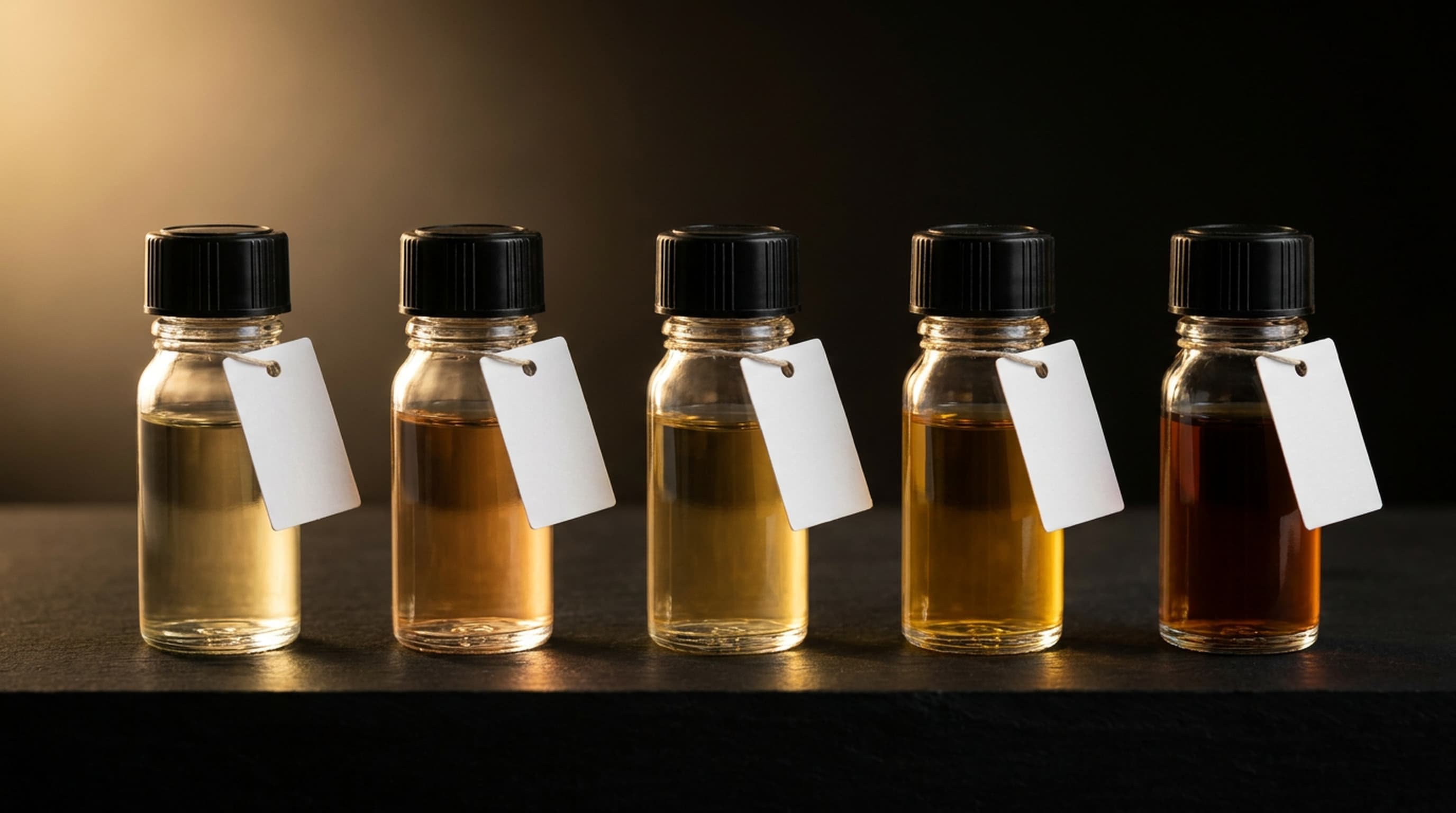
- Label every test batch, without exception
- Should I shake it every day?
- What if it is too strong?
- What if it is too weak?
- Building your own signature scent
- Work small, and keep records
- What if it goes cloudy or separates?
- The mistake that wastes the most time
- Frequently asked questions
- What to do next
You have just finished mixing your first perfume. You spray it on your wrist and something is off. The alcohol is loud. The opening is sharp. The notes are all standing next to each other rather than blending.
So the natural conclusion is that you got the formula wrong.
Probably not. You are smelling the perfume at the worst possible moment in its life. What happens after you mix is as much a part of perfume making as the mixing itself, and almost nobody tells beginners that.
So how long should it sit?
There is no universal number, and anybody quoting one flat rule is repeating something they read rather than something they tested.
A practical answer for a beginner: give it at least several days before you judge it at all, then keep evaluating across two to four weeks. Some formulas settle nicely inside a week. Others are still improving at week four.
Rather than obeying a rule, smell your own batch on a schedule and write down what changes:
Day 1
Your baseline. Expect sharp, alcohol forward and slightly disjointed. Note it and do not act on it.
Week 1
The alcohol usually recedes. The opening starts behaving like an opening rather than a blast.
Week 2
The heart becomes easier to find. This is often where a formula first smells like a perfume rather than a mixture.
Week 4
The base is properly apparent and the composition reads as one thing. Now you can judge it, and now a change is worth making.
Four data points and a notebook will teach you more about your own formulas than any number somebody gives you.
Why does perfume smell different after mixing?
Because at the moment of mixing everything has merely been put in the same bottle. The components have not yet settled into a relationship with each other or with the alcohol.
So immediately after mixing a perfume tends to smell:
- Sharp, with hard edges rather than a smooth opening.
- Alcohol forward, because the base is still the loudest thing present.
- Disjointed, with individual materials poking out of the composition.
- Stronger than you expected, and not in a flattering way.
- Different from the fragrance oil itself, which can be alarming the first time.
As it rests, the components integrate. The opening smooths, the heart emerges and the base becomes readable. This is why experienced perfumers do not evaluate a new formula on the first spray, and why you should not either.
Does resting make perfume stronger?
No, and this is the most important distinction in the whole article.
Maceration makes a perfume smoother, more blended and more cohesive. It does not add performance. Four weeks in a cupboard will not raise a concentration that was too low, and it will not turn a light citrus composition into something that holds for twelve hours.
Resting is part of the process, never a substitute for formulation. If the concentration was wrong or the raw materials are not performing, time will not correct it. It will just give you a well-integrated version of the same problem.
Where should it rest?
Not on a sunny windowsill, and certainly not in a parked car.
Somewhere:
- Out of direct sunlight.
- Away from heat, including the top of anything electrical.
- Cool and dry, at a fairly stable temperature.
- In a properly closed bottle, so you are not slowly evaporating the alcohol you paid for.
Heat, light and repeated temperature swings degrade fragrance, and Nigerian ambient conditions make that a real consideration rather than a theoretical one. A closed drawer is fine.
Label every test batch, without exception
Write the date, the fragrance and the concentration on every single bottle, at the moment you fill it.
Skip it once and two weeks later you will be holding five identical bottles trying to remember which one was 25 per cent and which was 30. At that point the entire experiment is worthless, because you can no longer attribute the result you liked to anything.
This is the cheapest discipline in perfumery and the one most often skipped.
Should I shake it every day?
No. Mix it thoroughly once, then leave it alone in a closed container.
Daily shaking is a ritual people adopt because it feels like progress. If your particular formulation calls for additional mixing, follow the formulation. Otherwise, consistency matters far more than agitation: the same treatment for every test batch is what makes the batches comparable.
What if it is too strong?
The usual route to this problem is wanting a powerful perfume, so pushing the fragrance load up until the spray is genuinely unpleasant.
Think in concentration rather than in more. In a 100ml batch at 25 per cent, the fragrance portion is 25ml and everything else together is 75ml. At 30 per cent it is 30ml of fragrance and 70ml of everything else. Write the target down before you pour, not after.
Over-concentration does not simply make a perfume louder. It can produce:
- An overwhelming opening that nobody wants to be near.
- A composition thrown out of balance, where one material dominates.
- Reduced wearability, especially in heat.
- Odd projection, so it is heavy up close and still does not carry.
- A cloudy or unstable mixture.
A perfume can get heavier without getting any louder. That is the trap. How to work out concentration properly.
What if it is too weak?
The opposite complaint, and just as common. You spray it and wonder where the fragrance went. Before you add more oil, work through five checks in this order:
- Have you actually let it rest?
- A fresh mix under-performs its finished self. If this batch is three days old, you do not yet know what it is.
- Are you nose-blind?
- Your nose stops registering a smell it is sitting in. Ask somebody else, or leave the room for twenty minutes. Do this before anything else, because it is free and it is frequently the answer.
- Is the concentration genuinely low?
- Check your own arithmetic before you assume the formula is at fault.
- Is the fragrance simply a light one?
- Some compositions are built from volatile materials and will never behave like an amber or an oud. That is a property of the concentrate, not a fault in your mixing.
- Is the formula balanced?
- A material added heavy-handedly, often a fixative, can flatten the whole thing. More oil is rarely the fix and often makes it worse.
If the answer really is that the concentrate is light, the material is the thing to change, not the percentage. The grade you start from does more for staying power than any adjustment you can make to the dilution.
Building your own signature scent
Once you are comfortable diluting a single fragrance oil, the interesting work is combining them into something that is yours.
Start from a concept, not from the shelf. Not let me mix five random oils, but a direction you can say out loud:
- Fresh, sophisticated, slightly spicy, woody.
- Creamy, floral, sensual, musky.
- Sweet, fruity, warm, addictive.
Then pick materials that serve that idea, and think in three layers: the top you notice first, usually the lighter and citrus materials; the heart that develops after the opening, where florals and spices live; and the base, the woods, musks, amber and vanilla that decide what is still there at the end of the day.
You do not have to follow the pyramid rigidly. Understanding it is what lets you diagnose a blend that opens beautifully and then collapses.
Work small, and keep records
Do not make a litre of an experiment. Make 20ml or 30ml, because your first attempt at a new direction is as likely to be terrible as excellent, and you want to find that out cheaply.
And record every blend: date, materials, quantities, percentages, batch size, then your observations at each interval. Something like:
Formula 001, 30ml batch. Material A 50 per cent, Material B 30 per cent, Material C 20 per cent. Day 1: sharp, C dominating. Week 2: settled, C now sitting under A. Week 4: balanced, would raise B slightly next time.
If you love it, you can make it again. If you hate it, you know exactly what to avoid. Without records you are relying on memory, and memory is genuinely bad at recalling whether you used 3ml or 5ml of something six weeks ago.
What if it goes cloudy or separates?
Do not ignore it, and do not panic either. The usual causes are water contamination from a damp bottle, a material that is not fully soluble at that level, too much of one ingredient, or simply a cold room.
While a batch rests, check it periodically for:
- Whether it stays uniform, or starts to layer.
- Whether it stays clear, if clarity is what you expected.
- Any sediment forming at the bottom.
- Any unexpected change in the smell itself.
For your own wear, mild haze is usually cosmetic. If you are preparing something for other people, stability matters much more and the cause is worth finding.
The mistake that wastes the most time
Your perfume is not lasting, so you increase the fragrance oil, add DPG, add a fixative, switch alcohol and raise the concentration. All at once.
Now it smells completely different, and you have no idea which change did what. You have spent materials and learned nothing.
Change one variable at a time. It feels slower and it is dramatically faster, because every batch then teaches you something you can reuse. That principle plus the notebook is most of what separates a formulator from somebody following recipes.
Frequently asked questions
How long should homemade perfume sit before using it?
Give it at least several days before judging it, then keep evaluating over two to four weeks. Some formulas settle within a week and others keep improving to week four. There is no single correct number, so test your own batch at day one, week one, week two and week four and record what changes.
What is maceration in perfume making?
The resting period after mixing, during which the fragrance materials and the alcohol integrate. A macerated perfume smells smoother and more cohesive than the same mixture did on day one, with a less aggressive opening and a more readable base.
Does letting perfume sit make it last longer?
No. Resting makes a perfume smoother and better blended, but it does not increase performance. If the concentration is too low or the materials are not substantive, time will not fix it. That comes from the formulation and the quality of the concentrate.
Can I use my perfume immediately after mixing?
You can, it is safe to wear, but you are not smelling the finished product. Fresh perfume is sharper and more alcohol forward than the same bottle will be in a month, so do not judge the formula or adjust it based on the first spray.
Should I shake homemade perfume while it rests?
No. Mix it thoroughly once, then leave it undisturbed in a closed container unless your formulation specifically calls for further mixing. What matters more is treating every test batch the same way, so the batches stay comparable.
Where should I store perfume while it macerates?
Somewhere cool, dry and dark, out of direct sunlight and away from heat, in a properly closed bottle. A drawer or a cupboard is ideal. Heat, light and repeated temperature swings degrade fragrance, which matters more in Nigerian conditions than in a cooler climate.
Why does my perfume smell like alcohol?
Usually because it has not rested yet and the alcohol is still the loudest thing in the bottle. It can also mean the fragrance concentration is lower than you wanted, or that the base you used carries its own odour. Leave it a week and smell it again before changing anything.
What to do next
If you mixed something yesterday and it smells wrong, do nothing. Label it, put it in a drawer and diarise four dates. Test at day one, week one, week two and week four. Write down what you notice each time.
When something does not work, find the reason before you reach for another ingredient. That single habit is the difference between following a recipe and actually learning to formulate.
For materials: perfume oils, perfumer’s alcohol, DPG, fixatives and bottles. For the full method, how to make perfume at home. And if you would rather not learn it by trial and error, the Complete Perfume Mastery Blueprint carries 25 tested formulas and the maturation notes for each.