
How to make perfume at home with fragrance oil and perfumer’s alcohol
The whole method in seven steps: what each ingredient does, how to work out concentration, how to mix it, and how to fix cloudy, harsh or weak results.
In this guide
- What you need
- What each ingredient actually does
- Can you use any alcohol?
- What percentage of fragrance oil should you use?
- How to calculate concentration
- Measure by weight, not by eye
- How to mix perfume: the seven steps
- Why does it smell harsh straight after mixing?
- Why does it smell strong at first and then vanish?
- Does more fragrance oil make it last longer?
- Why is my perfume cloudy?
- Seven mistakes that ruin first batches
- Making perfume to sell rather than to wear
- Frequently asked questions
- Start here
Making perfume at home is far easier than it looks from the outside. Two ingredients get you a wearable spray perfume: a fragrance oil and a suitable perfumer’s alcohol.
What it is not is oil plus alcohol equals perfume. The concentration you pick, the accuracy of your measuring, the order you add things in and the time you give it afterwards all change the result. This is the whole method, start to finish, with the four things that usually go wrong and what to do about each.
What you need
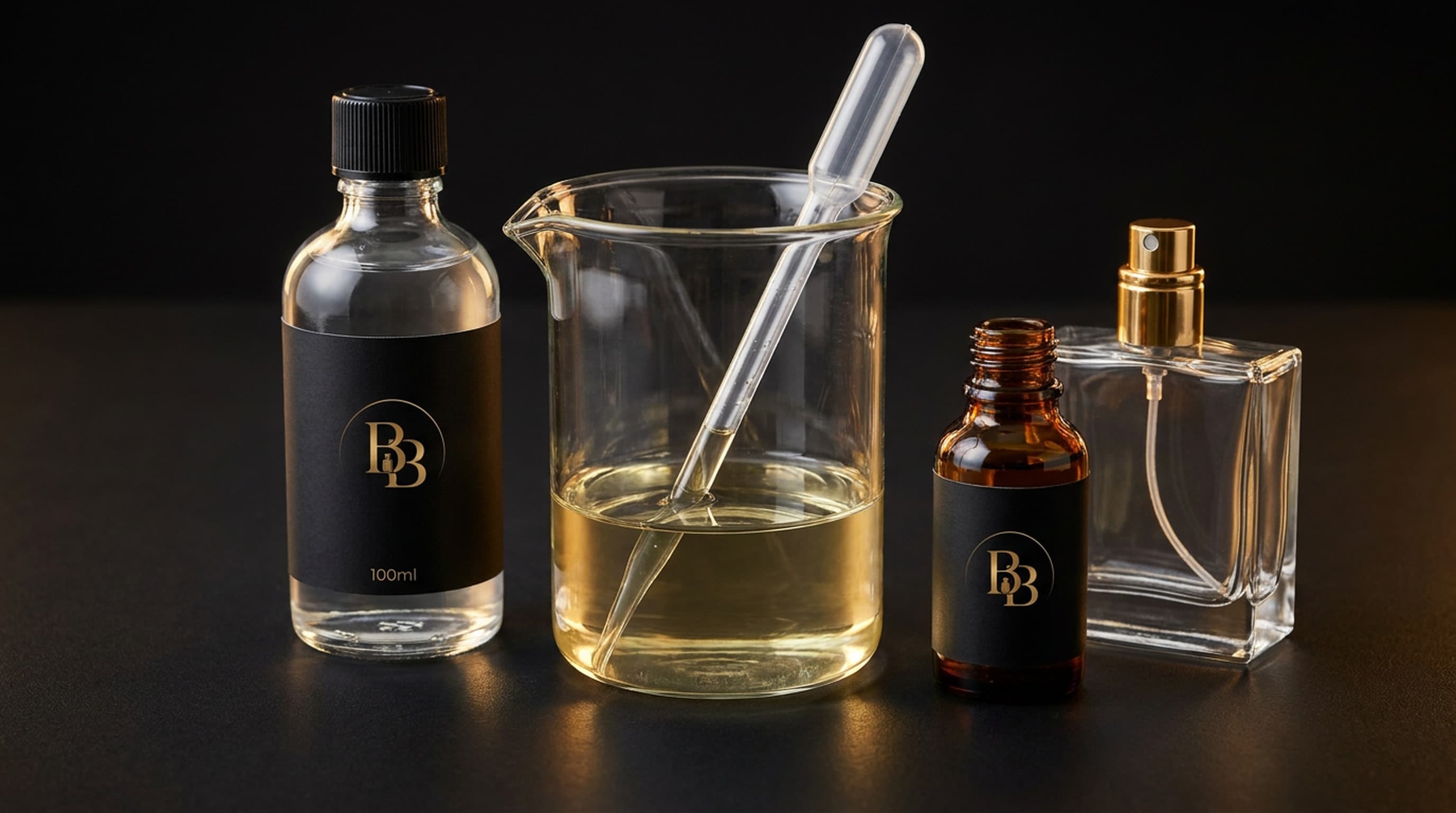
- Fragrance oil, which supplies the scent. Over 500 scents in five grades.
- Perfumer’s alcohol, the carrier that makes it sprayable. 50ml to 1 litre.
- A digital scale, reading to 0.01g if you can. The single most useful thing you will buy.
- A glass beaker and pipettes, for mixing and transferring.
- A bottle to keep it in. Glass and plastic, 3ml to 250ml.
- DPG, optional and formula dependent. What DPG is for.
- A fixative, optional and formula dependent. Fixatives.
- Labels and a notebook. You will regret skipping these by your fourth batch.
You do not need everything on that list to start. The first two and a scale will make you a real perfume. Everything else is there to solve a specific problem, and you should understand the problem before you buy the solution.
What each ingredient actually does
- Fragrance oil
- The scent itself, and the biggest single influence on your result. Two perfumes at the same concentration in the same alcohol can smell nothing alike, because the concentrate is doing the work. If the oil is light and citrus led, no amount of anything else turns it into an oud.
- Perfumer’s alcohol
- The solvent. It dissolves the fragrance materials, carries them, sprays evenly and then evaporates off your skin, leaving the fragrance to develop. It is why a spray perfume projects the way an oil does not. Perfumer’s alcohol vs ethanol covers which to use.
- DPG
- Dipropylene glycol, a solvent and carrier used to help incorporate or soften certain materials. It is not a longevity ingredient and adding more will not make a perfume last longer. Use it when a formula calls for it, not as a default.
- Fixatives
- Materials that slow the evaporation of the lighter parts of a fragrance, so the composition holds together for longer. Useful, and routinely oversold. How much fixative and DPG you actually need gives the starting ratios.
If somebody tells you one fixative will make any perfume last 24 hours, be careful. Longevity comes from the fragrance composition, the concentration, the raw material quality, your skin, the weather and how you applied it. One ingredient does not override all of that.
Can you use any alcohol?
No, and this is the mistake with the worst consequences.
Perfume goes directly onto skin and stays there, so the alcohol has to be intended for cosmetic or perfumery use. Methanol must never be used to make perfume. It is toxic, including through the skin, and no price saving is worth it.
Vodka and rubbing alcohol are not substitutes either, for less dangerous but still real reasons: vodka is heavily watered, which leaves the fragrance cloudy and poorly dissolved, and rubbing alcohol carries its own harsh smell that sits underneath everything you make.
Buy a base sold for perfumery, from somebody who can tell you what is in it. Perfumer’s alcohol is ready to use. Ethanol is the higher-strength option priced for volume work.
What percentage of fragrance oil should you use?
There is no one correct percentage, because it depends on the concentration you are aiming at and the materials in front of you. But the ranges are well established, and these are the names you already know from any perfume counter:
Eau de cologne
The lightest of the family. A brief, fresh wear that sits close to the skin.
Eau de toilette
Lower fragrance load. Lighter on the skin, shorter on the clock, easier in heat.
Eau de parfum
Higher fragrance load. Where most commercial perfume sits, and a sensible target for a first batch.
Extrait de parfum
Higher again. Richer, closer to the skin, and slower to leave. Our own ready-made line sits here.
For a first attempt, aim at an eau de parfum strength rather than the highest number you can manage. A perfume that is too concentrated does not become louder, it becomes heavy, and heavy is much harder to fix than light.
How to calculate concentration
The maths is one line: fragrance amount divided by final batch size, times 100.
So 25ml of fragrance in a 100ml final batch is 25 divided by 100, times 100, which is 25 per cent.
Read that the right way round, because this is the error that ruins first batches. At 30 per cent in a 100ml batch, the fragrance portion is 30ml and everything else together makes up the remaining 70ml. It is not 30ml of oil topped up with 100ml of alcohol. If your formula also uses DPG or a fixative, those come out of the 70ml, not out of thin air.
If you plan to sell, learn this calculation properly. Batch to batch consistency is the difference between a brand and a series of experiments, and a customer who loved the first bottle will notice.
Measure by weight, not by eye
Nothing else on this page will improve your perfume as much as this. Weigh your ingredients on a digital scale rather than estimating volumes.
Two reasons. Fragrance materials have different densities, so equal volumes are not equal amounts. And a repeatable number is the only way to reproduce a formula you liked, or diagnose one you did not.
How to mix perfume: the seven steps
- 1. Write the formula down first
- Batch size, target concentration, and the weight of every component. Decide before you pour, not while you pour.
- 2. Weigh the fragrance oil
- Into a clean glass beaker, on the scale, zeroed. This goes in first because it is the component you least want to get wrong.
- 3. Add any other fragrance materials
- DPG, fixative, or anything else the formula calls for. Only what the formula calls for.
- 4. Add the perfumer’s alcohol
- Last, and up to the batch size. Adding the base first and the oil after makes accurate weighing much harder.
- 5. Mix until fully incorporated
- Swirl or stir gently until it is uniform and clear. Violent shaking is not required and does nothing useful.
- 6. Bottle it
- Into a clean, dry bottle, closed properly. Water is the enemy here: a wet bottle is one of the most common causes of cloudiness.
- 7. Label it and let it rest
- Date, scent and concentration on the label. Then leave it alone. How long homemade perfume should sit explains what happens next.
That is the whole process. The skill is not in the pouring, it is in the decisions you made in step one.
Why does it smell harsh straight after mixing?
Because you are smelling it at the worst possible moment. A freshly mixed perfume is sharp, alcohol forward and slightly disjointed, and that is normal rather than a sign you formulated it wrongly.
Give it days rather than minutes, then evaluate it again at a week, two weeks and four. The opening usually smooths out, and the base becomes easier to find. Do not adjust a formula on the strength of the first spray.
Why does it smell strong at first and then vanish?
The most common complaint in home perfumery, and there are five possible causes. Work through them in this order before you change anything:
- You have gone nose-blind. Your nose stops registering a smell it has been sitting in. Ask somebody else, or leave the room for twenty minutes and come back. Do this check first, because it is free and it is often the answer.
- The top notes have simply done their job. Citrus and other light materials are supposed to leave early. What you smell after an hour is the perfume; what you smelled at first was the introduction.
- The fragrance itself is light. Some compositions are built from volatile materials and will never behave like an amber or an oud.
- The concentration is too low for the performance you were hoping for.
- Your skin. Dry skin holds fragrance poorly. The same perfume genuinely does last longer on some people than others.
Only after all five does adding more oil become a sensible idea. Why perfume smells strong at first goes further into what you can do about it.
Does more fragrance oil make it last longer?
Not reliably, and past a point it makes things worse.
A higher load can add intensity and some persistence. It can also unbalance the composition, change the skin feel, make the spray sit oddly, push the perfume cloudy and take you past sensible usage levels for the materials involved. A perfume can get heavier without getting any louder.
If you want longer wear without a formulation fight, the grade of oil you start from does more than the percentage you mix at. That is the whole point of the five grades: the same scent, from about six hours at Premium to past forty-eight at 2x Alpha.
Why is my perfume cloudy?
Cloudiness has a handful of usual causes, and they are all fixable:
- Water got in, from a damp bottle, a rinsed beaker or a watered-down base.
- Something in the formula is not fully soluble at that level.
- There is too much of one material, often a fixative.
- It is simply cold. Some formulas haze at low temperature and clear again as they warm.
- The fragrance oil contains materials that behave differently in alcohol than in oil.
Cloudy does not automatically mean spoiled. But if you are selling it, find the cause rather than shipping it, because a customer will read haze as a fault whether it is one or not.
Seven mistakes that ruin first batches
- Measuring by eye instead of by weight.
- Using an alcohol that was never meant for skin.
- Adding a fixative because somebody online said to.
- Adding DPG for longevity it does not provide.
- Judging the perfume ten minutes after mixing it.
- Changing five things at once, so no result can be attributed to any cause.
- Keeping no records, then being unable to reproduce the one batch that worked.
Change one variable at a time. It sounds slow, and it is the fastest way to get good, because every batch then teaches you something you can use.
Making perfume to sell rather than to wear
The two are genuinely different undertakings. Experimenting for yourself gives you room to learn by trial and error. Selling to customers brings in consistency, labelling, batch records and the applicable rules for the product category, so check the current requirements before you scale up.
If a fragrance is inspired by a designer or niche perfume, present it honestly: your own product inspired by a known profile, not affiliated with or endorsed by the original house. How we describe our inspired range is a usable template.
And if you want the numbers side, how to start a perfume business in Nigeria covers costing, pricing and finding customers.
Frequently asked questions
What do I need to make perfume at home?
At minimum, a fragrance oil, a perfumer's alcohol suitable for cosmetic use, a digital scale, a glass beaker and a clean bottle. DPG, fixatives, pipettes and labels are useful additions but not required for a first batch.
How much fragrance oil do I put in 100ml of perfume?
It depends on the concentration you want. At 25 per cent, the fragrance portion of a 100ml batch is 25ml and everything else together makes up the other 75ml. At 30 per cent it is 30ml of fragrance and 70ml of everything else. The remainder is not automatically all alcohol if your formula also uses DPG or a fixative.
Can I use vodka or rubbing alcohol to make perfume?
Neither is a good substitute. Vodka carries a lot of water, which leaves the perfume cloudy and the fragrance poorly dissolved. Rubbing alcohol has its own harsh odour that sits under everything you make. Methanol must never be used at all, because it is toxic including through the skin.
Do I need DPG and a fixative in every perfume?
No. Both are formula dependent. Many fragrance concentrates already contain materials that contribute to persistence, and adding DPG or fixative without a reason changes the balance of a formula that was working. Understand what the ingredient does before it goes in.
How long does homemade perfume take to be ready?
Give it at least several days before you judge it, then keep evaluating it across two to four weeks. A freshly mixed perfume smells sharper and less integrated than the same perfume will after it has rested, so the first spray is not a fair test.
Why does my homemade perfume smell like alcohol?
Usually because it has not rested yet, and the alcohol is still the loudest thing in the bottle. It can also mean the fragrance concentration is low for what you were expecting, or that the base you used carries its own odour. Let it sit for a week and smell it again before changing anything.
Is it cheaper to make perfume than to buy it?
Per bottle, usually yes, once you have the base ingredients, because you are buying materials rather than branding, retail margin and import cost. The saving only holds if you are not throwing batches away, which is why measuring and record keeping matter.
Start here
Make 30ml, not 500ml. Weigh everything. Write it down. Let it rest a week. Change one thing. That loop, run four or five times, will teach you more than any single recipe.
For the ingredients: perfume oils, perfumer’s alcohol, ethanol, DPG, fixatives and bottles, all in one order. Or take a ready-made DIY bundle if you would rather not assemble the list yourself.
And if you would rather not learn it by trial and error at all, the Complete Perfume Mastery Blueprint is 25 tested formulas, the full ingredient palette at 2026 Nigerian prices, and a 90 day plan to a profitable line.