
How to start a perfume business in Nigeria
No shop, no factory, no millions. What to sell, what it really costs, how to price it so you keep something, and how to find your first ten customers.
In this guide
- Is a perfume business actually profitable in Nigeria?
- How much do you need to start?
- Can you run it from home?
- What should you sell first?
- Designer inspired, or your own fragrance?
- How many fragrances should you start with?
- Which bottle sizes should you stock?
- How to price it so you actually keep something
- Getting your first ten customers
- Selling perfume on WhatsApp
- Seven mistakes that cost beginners money
- Starting with a Business Starter Pack
- If you want to make the perfume, not just resell it
- Frequently asked questions
- What to do this week
A perfume business is one of the very few product businesses in Nigeria you can genuinely start from a bedroom. No factory, no shopfront, no import licence and no staff sit between you and your first sale.
What does sit there is arithmetic. Most people who quit inside six months did not fail at fragrance. They failed at cost per bottle, or they bought twenty scents nobody ever asked them for. So this guide starts with the numbers rather than the dream.
Is a perfume business actually profitable in Nigeria?
Yes, and the margins are genuinely good. But profitability is not automatic, and it is mostly decided before you sell anything, at the moment you choose what to buy.
Six things set your profit:
- What you pay for the oil, measured per millilitre rather than per bottle.
- The grade you choose, because longevity is what your customer is actually paying extra for.
- Your bottle, label and packaging cost.
- Your selling price, and whether your market will genuinely pay it.
- How fast the stock moves.
- How many of those buyers come back a second time.
Only one of those six is the price of the oil. Buying the cheapest oil available is not a strategy if the fragrance is gone in ninety minutes and nobody reorders.
The goal is not to buy cheaply. It is to buy well and sell profitably. Those are two different decisions, and only one of them shows up in your bank account.
How much do you need to start?
There is no single figure, because this business scales down further than most people expect. You can start with two fragrances and a hundred roller bottles, or with twelve fragrances and a full retail range.
At any level the money goes to the same five places:
- Oil, or finished perfume
- Your largest line by far. If you are reselling oils you buy 100ml to 500ml and decant into retail sizes. Compare the five grades and their prices, or start from which grade you should buy.
- Retail bottles
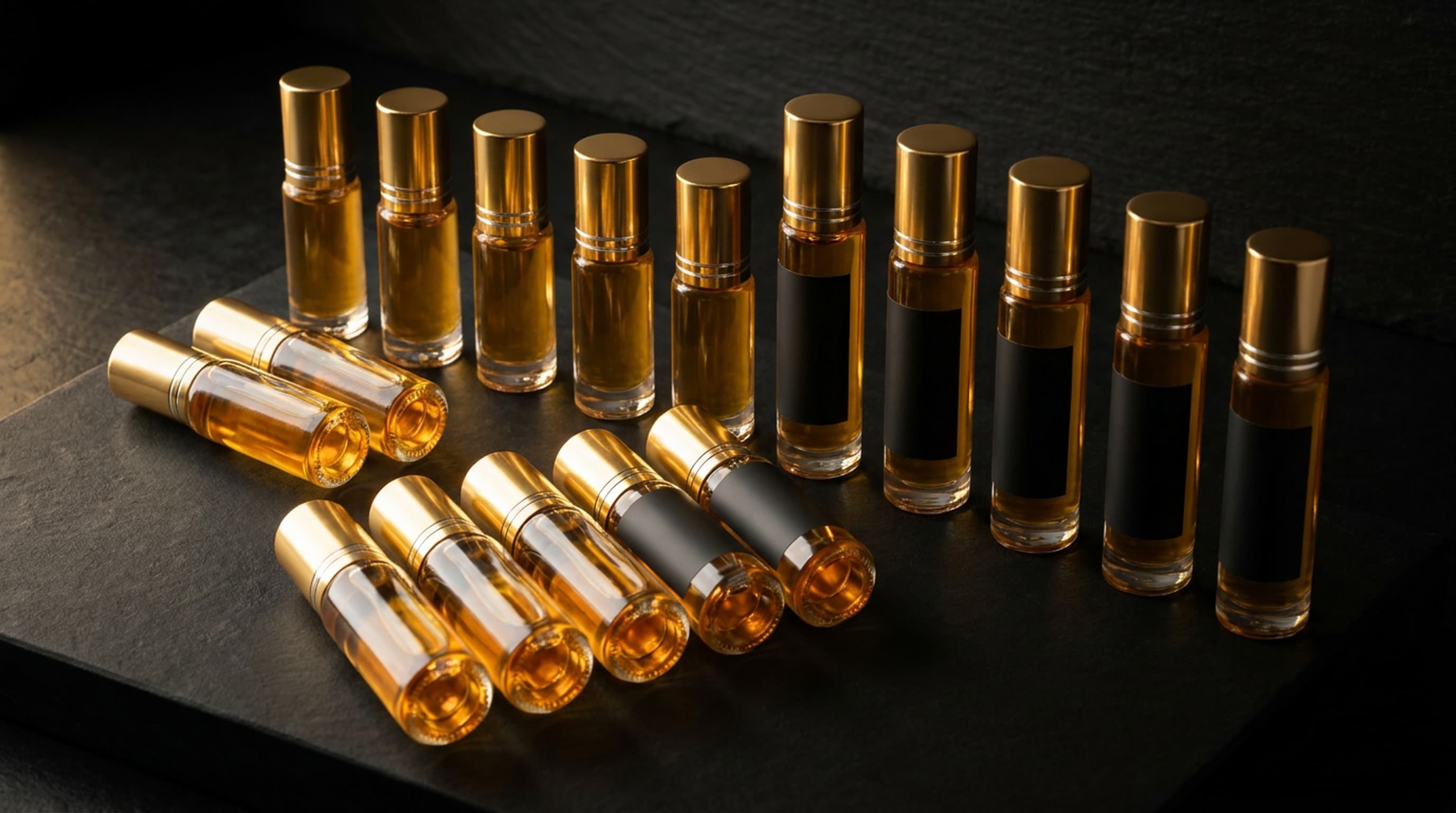
- 3ml and 6ml rollers are where most Nigerian first sales happen, because they let a stranger try you for under two thousand naira. Bottles run 3ml to 250ml, glass and plastic.
- Labels and packaging
- Clean beats expensive every time. A plain label and a satin bag outperform a busy design. Satin bags, nozzles and droppers.
- Filling equipment
- A digital scale, a funnel and a few pipettes. The smallest line on your list, and the one beginners skip hardest.
- Marketing
- Zero naira to begin with. WhatsApp Status, Instagram and TikTok cost you time, not capital. Spend the capital on stock instead.
The mistake is thinking you need half a million naira before you are allowed to begin. The better question is what you can start with, and how fast you can turn that stock back into capital.
Can you run it from home?
Yes, and for your first few months you should. Rent is the fastest way to turn a working margin into a loss.
A home operation looks like this: hold only the stock you can sell in a month, photograph it properly once, post daily, take orders on WhatsApp, pack on one fixed day and dispatch on another.
Take a shop when the order volume forces you to, not when you want the business to feel legitimate. Your first job is proving that people will pay you.
What should you sell first?
Here is the most expensive beginner mistake in the whole business: buying the fragrances you personally love.
You are not shopping. You are buying inventory for other people, and their taste is not yours. Spread that first order across the directions Nigerian buyers actually ask for:
- Sweet and gourmand. The vanilla, caramel and dessert crowd. Consistently the fastest mover.
- Fresh and clean. Office wear, daytime, Lagos heat.
- Woody and oud. Where the higher price points live, and where oud requests never stop.
- Floral. For the soft feminine request you will get every single week.
- One or two unisex. So you always have an answer for a gift buyer.
That is five directions, not fifty fragrances. Browse over 500 scents and pick the smallest set that covers all five.
Designer inspired, or your own fragrance?
Both work. They are different businesses.
Designer and niche inspired oils sell faster because the customer arrives already knowing what they want. Someone names a fragrance they love and you can answer in one message. That is a far shorter conversation than teaching a stranger a scent from nothing.
If you go that route, be straight about it. What you sell is your own fragrance inspired by a known profile, not the original, and not affiliated with or endorsed by the house that made it. Say so in your captions and on your label. Here is how we describe our own inspired range.
Building an original brand identity is the slower and more defensible route. Nothing stops you doing both: sell inspired oils to fund the brand you actually want.
How many fragrances should you start with?
Fewer than you want to.
Six to ten is plenty for a first order, and the reason is information rather than caution. With ten fragrances you learn inside a month which three carry the business. With fifty, your capital is spread so thin that nothing tells you anything and most of it is standing still.
Picture buying fifty scents and finding out your customers only ever ask for ten. The other forty are not stock. They are money you cannot spend.
Which bottle sizes should you stock?
Bottle size is a pricing decision, not a packaging one. Each size buys you a different customer.
- 3ml and 6ml
- Your trial sizes, and the bulk of first orders. Small enough that a new customer takes the risk without thinking about it too hard.
- 10ml to 20ml
- The repeat purchase. Someone who liked the 3ml comes back here, and this is where your margin per order improves.
- 30ml
- Middle ground, and the size that gifts well.
- 50ml and 100ml
- For customers who already know exactly what they want. Higher value, slower turnover, worth carrying only once you know your best sellers.
You do not need all of them. Two is enough to start: one trial size and one repeat size.
How to price it so you actually keep something
Do not add a round number to what you paid for the oil. Work out your true cost per finished bottle, and include all of it:
- The oil, at what that particular fill actually costs you.
- The bottle, and its cap or roller.
- The label.
- The bag, tissue or box it leaves in.
- Any delivery you absorb rather than charge.
- Transfer and payment charges.
- Breakage and spillage, because there will be some.
Then set the price from that number and what your market will bear. Worked example: a finished 6ml bottle that costs you ₦2,000 all in and sells at ₦5,000 leaves ₦3,000 a bottle, which is ₦150,000 across fifty bottles.
That ₦150,000 is gross margin, not profit. Delivery, data, ads, breakage and packaging still come out of it. Revenue is not profit, and the gap between the two is where new businesses quietly die.
Getting your first ten customers
Your first ten come from people who already know you. Not strangers, not the algorithm. Family, colleagues, neighbours, your church or mosque, the contacts already sitting in your phone.
How you ask decides whether it works. This does nothing: I have started selling perfume, please support me.
This works: I have started selling perfume oils in 3ml and 6ml. I have sweet, fresh, woody and unisex. You usually wear something sweet, so let me show you three.
The second version does the thinking for them. Then ask the ones who loved it for a message you can screenshot and post, with their permission.
Selling perfume on WhatsApp
For most Nigerian fragrance businesses WhatsApp Status is the entire shopfront. Treat it like one.
The posts that do nothing all look identical: a bottle, a price, the word available. Nothing in that helps anybody decide. Rotate through seven kinds of post instead:
- The scent. What it actually smells like, in plain words. Opens fruity, dries down warm and creamy.
- The problem. Does your perfume vanish by lunchtime? Then answer that.
- Proof. A customer's message, shared with their permission.
- Behind the scenes. Filling, labelling, packing. The post that builds trust fastest.
- Education. The difference between two grades, and why one costs more.
- The range. Sizes and prices, so nobody has to ask for the basics.
- The ask. Message me and tell me what you normally wear.
People buy from a seller who clearly knows what they are recommending. That knowledge is the whole advantage you hold over a cheaper competitor, so put it on display.
Seven mistakes that cost beginners money
- Buying too much stock too early
- Dead stock is capital you cannot use. Buy what you can move in a month, then buy again.
- Buying only what you like
- Your own taste is one data point out of hundreds. Treat it as one.
- Pricing before costing
- If you do not know your cost per finished bottle, you do not know whether you are making money. You only know money is moving.
- Competing on price alone
- Somebody will always go lower. Compete on what you know, what you stock and how reliably you deliver.
- Spending every naira on stock
- Keep a float for bottles, delivery, data and the reorder. A business with no working capital stalls at its first good week.
- Ignoring what customers ask for
- Every request is free market research. Write them down. Your next order should look like that list.
- Expecting it to be quick
- A repeat customer base takes months, not weeks. The businesses that survive are the ones still posting in month four.
Starting with a Business Starter Pack
If sourcing oils, bottles and packaging separately feels like three problems at once, the starter packs collapse it into one order. Each one is finished 50ml oils plus empty rollers: you decant and resell, nothing is mixed and nothing is formulated.
Premium, ₦66,000
6 x 50ml oils, 48 x 3ml rollers and 36 x 6ml rollers. Holds about six hours. Minimum retail of ₦102,000 at the suggested floor prices.
Top, ₦77,000
The same kit at Top grade, which holds 6 to 12 hours. Minimum retail of ₦144,000.
Super, ₦109,500
The same kit at Super grade, 12 to 24 hours, and the grade most resellers settle on. Minimum retail of ₦186,000.
There is a 12 scent version of each, and you choose your fragrances from a shortlist. See both kit sizes and all three grades.
Those retail figures are what the pack sells for at the suggested floor prices. They are potential revenue, not guaranteed profit: your own delivery, packaging and expenses still come out of the difference.
If you want to make the perfume, not just resell it
Reselling oils and making perfume are two businesses with two different margins. Making it is where the margin roughly doubles, and it is also where most people get stuck, because concentration, fixatives and maturation are not guessable.
There are two routes. The free one: start with how to make long lasting perfume at home, then how much fixative and DPG you actually need. Nothing is held back on either page.
The faster one: the Complete Perfume Mastery Blueprint carries 25 tested per-fragrance formulas, real 2026 Nigerian costings, pricing and packaging, and a 90 day plan from zero to a profitable line. It is the shortcut past six months of buying the wrong materials.
Frequently asked questions
How much do I need to start a perfume business in Nigeria?
There is no universal figure, because the business scales down a long way. A Business Starter Pack begins at ₦66,000 and gives you six 50ml oils plus 84 roller bottles to decant into, which is enough stock to test a market. Sourcing separately, your floor is one or two oils, a hundred rollers, labels and a scale.
Is the perfume business profitable in Nigeria?
It can be, and the margins are good, but profitability depends on your cost per finished bottle, your selling price, how fast the stock moves and your operating expenses. A seller who buys badly and prices without costing can turn over a lot of money and keep very little of it.
Do I need a shop to sell perfume?
No. Most Nigerian fragrance businesses run entirely on WhatsApp, Instagram and TikTok, from home. Rent is the fastest way to turn a working margin into a loss, so prove people will buy from you first and take a physical location when order volume forces it.
Should I sell perfume oils or ready-made perfume?
Oils let you split one purchase into many price points, so your capital works harder and a stranger can try you for very little. Ready-made bottles tie your capital up in finished units but need no filling or labelling. Many sellers start with oils and add finished perfume once they know their best sellers.
How many fragrances should I start with?
Six to ten. Enough to cover sweet, fresh, woody, floral and unisex, and few enough that within a month you can see which three are carrying the business. Fifty fragrances spread your capital so thin that nothing tells you anything.
Do I need to register the business before I start selling?
You can begin selling while you look into it, but check the current requirements for the product category you are selling and register when your volume justifies it. If you intend to make and sell your own perfume rather than resell, look into the applicable rules for cosmetic products before you scale.
Where can I buy perfume oils wholesale in Nigeria?
Beyond The Bottle supplies perfume oils in five grades from 100ml to 10 litres, with reseller pricing on volume, plus bottles, labels, perfumer's alcohol and starter packs. Delivery is nationwide, dispatched Fridays and Saturdays, and Lagos customers can collect instead.
What to do this week
Do not wait until you have everything figured out. Do these five things in order:
- Pick five fragrance directions, and the smallest set of scents that covers them.
- Cost one finished bottle, all in, before you order anything.
- Set your trial price and your repeat price from that number.
- Message ten people you already know, specifically, about what they already wear.
- Post every day for two weeks, rotating the seven post types above.
Then let the orders decide your second purchase. A perfume business that starts from a few bottles at home and restocks from real demand ends up somewhere. One that starts from fifty guesses usually does not.
When you are ready to buy: the Business Starter Packs, perfume oils by grade, bottles, or message us and tell us your budget and who you are selling to.