
How to test perfume oils before buying in bulk
The expensive mistake is a litre of oil that does not work in your product. A twelve step R&D process to choose, test and approve a fragrance before you scale.
In this guide
- Why testing before bulk matters
- Step 1: Write the product brief
- Step 2: Choose the grade you will actually sell
- Step 3: Shortlist your candidates
- Step 4: Buy manageable testing quantities
- Step 5: Smell each oil neat, and record it
- Step 6: Make small batches under identical conditions
- Step 7: Test the concentration too
- Step 8: Let every batch rest
- Step 9: Test on blotter, skin and fabric
- Step 10: Do not rely on your nose alone
- Step 11: Change one variable, and keep a record
- Step 12: Compare the finalists fairly
- Testing a blend rather than a single oil
- When to move from testing to bulk
- Frequently asked questions
- R&D should reduce guesswork
One of the most expensive mistakes in perfume is buying a large quantity of oil before you know it works in your product. A litre of the wrong fragrance is not stock. It is capital you cannot spend.
R&D, research and development, is how you avoid that: test the fragrance, build the formula, evaluate the result and adjust, all while the money at risk is small. The goal is not to find an oil that smells good from the bottle. It is to find one that works in the finished perfume you actually intend to sell.
Why testing before bulk matters
An oil can smell excellent neat and still fail as a product. Once diluted its character shifts, and you may find it is too sweet, too woody, too weak, too heavy, too sharp, badly balanced, poor at projecting, or simply wrong for what you are making.
Better to learn that from 100ml than from a litre. Instead of buying a litre each of five fragrances and discovering only one works, test all five, drop the ones that do not fit, and put the money behind the one that does.
Step 1: Write the product brief
Before choosing any oil, decide what you are making. Not which oil is best, but which oil is right for this product. A brief answers four things:
- The product
- An everyday spray, a luxury extrait, a roll-on oil, a unisex signature, a wedding souvenir, a refill line, a custom scent for a client. Each has a different target.
- The customer
- Age, gender positioning, occasion, price point, taste. A soft, understated office scent and a rich evening statement are developed differently.
- The scent direction
- Sweet and feminine, clean and fresh, dark and mysterious, warm and sensual, woody and polished, unisex and balanced. Write it down so you can judge against it.
- The performance target
- How long it should hold, how far it should project, and whether longevity matters more than price. This is what decides the grade.
Step 2: Choose the grade you will actually sell
This is the rule that catches more businesses than any other: test the same grade you intend to use in production.
Grade changes how long a fragrance holds. Approve a formula on Top and produce on Super, and the perfume your customer buys will not behave like the one you tested. If the finished product will be Super, test Super. If Alpha, test Alpha. The highest grade is not automatically right, either: it has to match the performance target and the price your customer pays. Compare the five grades.
Step 3: Shortlist your candidates
Pick several oils that could meet the brief, not every oil that could. For a sweet feminine perfume, choose a few different interpretations of sweetness. For a luxury unisex, compare options across woody, amber, floral, musk and gourmand. The first round exists to narrow the field, not to perfect anything.
Browse over 500 scents with the brief open beside you.
Step 4: Buy manageable testing quantities
How much depends on how many oils you are testing and how many rounds of adjustment you expect. One or two fragrances need little. Five or more need enough to repeat tests after you adjust.
Our oils start at 100ml, which suits most R&D. If you are testing up to five fragrances, we can also supply 50ml of each, so you can compare a full shortlist without committing to a full size of every one. Message us with the scents and grade.
Step 5: Smell each oil neat, and record it
Before formulating, smell each oil on its own for a baseline: first impression, strength, main character, sweetness, freshness, woods, florals, musk, spice and overall appeal.
You may rule one out immediately because it plainly does not fit the direction. That is a successful result. You have just avoided building a product around the wrong fragrance.
Step 6: Make small batches under identical conditions
Make small test batches in the format you will sell, and keep everything identical except the oil: the same batch size, target concentration, alcohol or base, DPG, fixative, testing method and evaluation schedule. Then the fragrance is the only thing you are comparing.
Use your intended production format. If the product is an eau de parfum, test it as one. If it is a roll-on, test it in DPG. Spray starting ratios and roll-on starting ratios are both on this site.
Step 7: Test the concentration too
The same oil behaves differently at different strengths: bright and airy at one, rich and heavy at another. So test two sensible concentrations of your leading candidate and compare opening, projection, sillage, dry-down, longevity and balance.
The highest concentration is rarely the best perfume. And before settling on a commercial concentration, check the supplier's safety documentation and usage limits for that fragrance.
Step 8: Let every batch rest
A fresh mixture smells sharper and less integrated than it will. Check it immediately, after several days and after a few weeks, and note whether the alcohol recedes, the balance improves and the dry-down gets better.
Consistency matters more than any particular number of days. If you approve one candidate after 24 hours and another after three weeks, you have not compared them. What resting does.
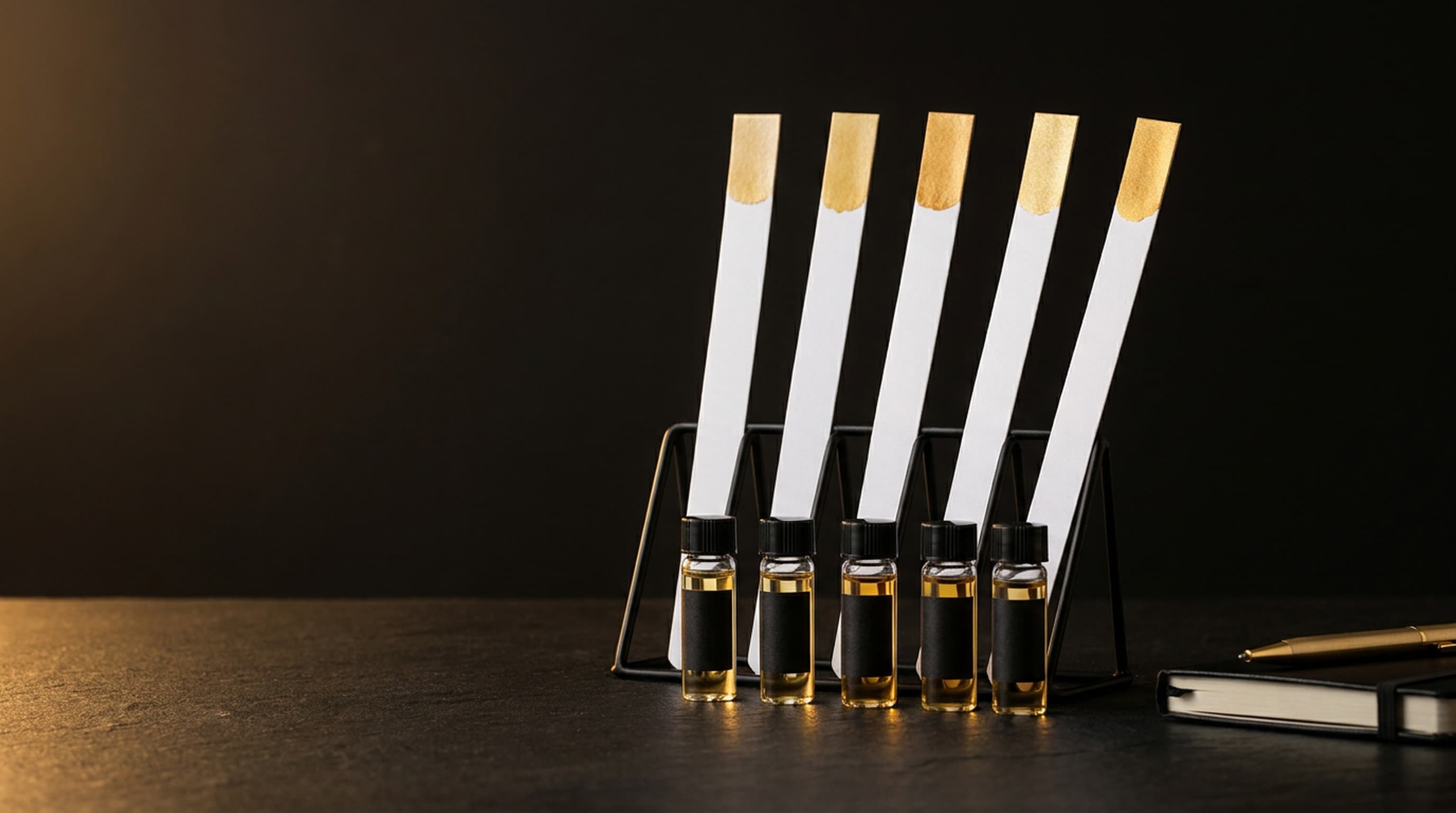
Step 9: Test on blotter, skin and fabric
- Blotter
- Fast and fair for comparing several formulas side by side, and good for studying the opening and dry-down.
- Skin
- The real wearing experience. Follow it at thirty minutes, an hour and several hours for opening, development, projection, dry-down and longevity.
- Fabric
- A useful extra reference, but it holds fragrance far longer than skin, so never treat the two results as the same thing.
Step 10: Do not rely on your nose alone
Your nose adapts to a smell it is sitting in, and you will stop noticing a perfume that other people can still smell clearly. Step away between checks instead of smelling your wrist every five minutes.
Ask other people too, but let their feedback inform the process rather than replace it. Your target customer matters more than one friend's taste.
Step 11: Change one variable, and keep a record
If a formula underperforms and you change the oil, concentration, DPG, fixative, alcohol and blend all at once, the next version may be better and you will have learned nothing. Test concentration with the oil held constant. Compare oils with the formulation held constant.
And write it all down. For every test: fragrance, grade, supplier, test quantity, batch size, concentration, base, DPG, fixative, date mixed, first impression, projection, dry-down, longevity, skin and fabric results, what you would change, and a decision: approve, modify or reject. A formula you cannot reproduce is not a formula.
Step 12: Compare the finalists fairly
Put the survivors side by side, same grade and same concentration, and ask: which has the best opening, the most appealing dry-down, the best fit for the customer, enough projection and enough longevity for this product, and the best balance?
Keep quality and suitability separate. An oil can be excellent and still wrong for this product. A beautiful heavy wood is a poor choice for a soft feminine brief, and that says nothing bad about the oil. Ask whether it is good, then ask the question that matters: is it right for this?
You may find your personal favourite is not the best commercial choice. That is R&D working.
Testing a blend rather than a single oil
If the product is a combination of oils, R&D matters even more, because several oils that are excellent alone can be muddy together. Do not make 500ml of a new blend. Trial small versions, such as oil 1 with oil 2, oil 1 with oil 3, and all three together, then refine the one that shows promise.
The loop is always the same: test, evaluate, adjust, retest, approve, scale. The full blending method.
When to move from testing to bulk
Liking the fragrance is not a reason to scale. Before you buy in quantity you should be able to tick every one of these:
- The fragrance fits the product brief.
- You tested the grade you will produce with.
- The concentration has been evaluated.
- The formula has rested and been re-evaluated.
- Projection, longevity and dry-down have been assessed on skin.
- The formula is fully documented.
- The applicable safety information has been checked.
- The production cost fits your target selling price.
- You can reproduce the result.
Then buy in quantity: 100ml to 500ml from any scent page, and 2 to 10 litres on request. Moving a formula up to that volume without changing the scent is its own discipline: how to scale a perfume formula.
Frequently asked questions
How do I test a perfume oil before buying in bulk?
Write a brief for the product, shortlist several oils, buy small testing quantities in the grade you will produce with, and make small batches under identical conditions. Rest them, test on blotter and skin at fixed intervals, record everything, and only scale the one that meets the brief.
How much perfume oil do I need for R&D?
It depends on how many fragrances you are testing and how many rounds of adjustment you expect. Our oils start at 100ml, and if you are testing up to five fragrances we can supply 50ml of each so you can compare a full shortlist.
Why should I test the same grade I plan to produce with?
Because grade changes how long the fragrance holds. A formula approved on one grade and produced on another can perform differently in the finished bottle, so your test would not represent the product your customers actually buy.
How long should I test a perfume before deciding?
Evaluate it immediately, after several days and after a few weeks, and follow each skin test for several hours. Use the same schedule for every candidate so the comparison is fair.
Can I test perfume oils on paper instead of skin?
Paper blotters are good for comparing several formulas quickly, but they do not show the real wearing experience. Use blotters to narrow the field, then test the finalists on skin before approving anything.
What should I record during perfume R&D?
The fragrance, grade, supplier, quantity, batch size, concentration, base, any DPG and fixative, the date mixed, your observations on opening, projection, dry-down and longevity, skin and fabric results, planned changes and the final decision.
Do I need to buy lots of raw materials to start R&D?
No. If you are developing a perfume from ready-made fragrance concentrates, small quantities of suitable perfume oils are enough to find your direction. Validate the fragrance, the grade and the formulation first, and only then move into production quantities.
R&D should reduce guesswork
The point of all this is not to make perfume complicated. It is to make your decisions better. Instead of wondering whether a fragrance will work, test it. Instead of wondering whether a grade will perform, test that grade. Instead of making a litre of an unproven blend, make 30ml first.
Start small. Test the grade you will produce with. Record everything. Adjust carefully. Then scale what works.
For testing quantities, message us with your shortlist and grade. For tested per-fragrance formulas that skip much of the first round, see the Complete Perfume Mastery Blueprint.